
Reviewed · HONOLULU CITY TOURS
Bishop Museum General Admission Ticket
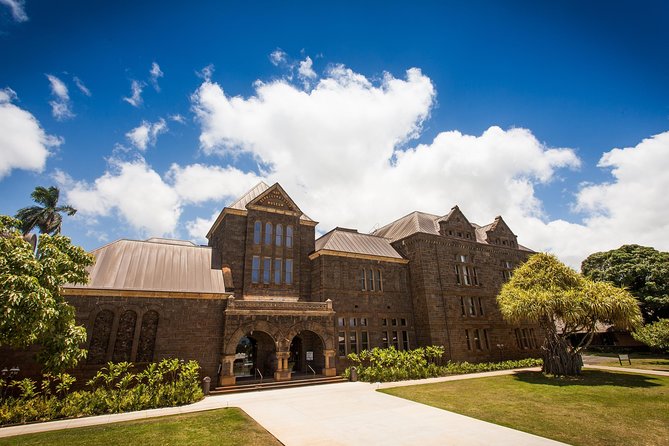
Bishop Museum is the place to go when you want more than beaches and resort views. Its Hawaiian Hall holds royal objects, featherwork, woven mats, fishing tools, art, and stories that give real shape to Hawaiʻi’s past, while Pacific Hall widens the picture to include the people and voyages that settled Polynesia.
I especially like the beautiful historic buildings and the way the museum connects culture with science. The planetarium adds a memorable look at Polynesian navigation, and the Richard T. Mamiya Science Adventure Center gives children something hands-on to do. The main drawback is size: two hours feels rushed, and some areas, shows, or buildings may be closed when you visit.
In This Review
- Key things to know before you go
- Why Bishop Museum belongs on your Honolulu plan
- Hawaiian Hall: the best place to begin
- Pacific Hall and the story of ocean migration
- The planetarium and Polynesian knowledge of the sky
- Science Adventure Center and the live lava program
- Castle Memorial Building and changing exhibits
- How much time should you allow?
- Is the $38.95 admission a good deal?
- Who will enjoy Bishop Museum most?
- Practical booking advice
- Should you book Bishop Museum?
- FAQ
- What does the Bishop Museum admission ticket include?
- Is the planetarium included in admission?
- How long should I plan for Bishop Museum?
- Is the live lava demonstration included?
- Is parking included?
- Are special exhibits included?
- Is Bishop Museum suitable for children?
- Is the museum accessible by public transportation?
- What is the cancellation policy?
Key things to know before you go
- Hawaiian Hall is the essential stop: Allow time for royal objects, feathered kahili, woven mats, fishing tools, and displays on Hawaiian traditions.
- Pacific Hall puts Hawaiʻi in a larger story: You’ll learn about Pacific migration, settlement, values, and shared cultures.
- The planetarium is not included: Its astronomy programs are optional, and availability can change, so check before counting on a show.
- The science center works best for families: Interactive exhibits explain volcanoes, lava, and the formation of the Hawaiian Islands.
- Plan at least half a day: The campus is large, with several buildings and plenty of reading.
- The $38.95 price needs a little thought: It can be good value if you spend several hours inside, but less so if major areas are closed or you only have a short visit.
Why Bishop Museum belongs on your Honolulu plan
Bishop Museum gives you context that a sightseeing drive cannot. You can look at a royal feather cape, a carved object, or a traditional tool and then learn how it fit into Hawaiian life. That makes the visit useful early in your stay, before you spend time at historic sites, cultural performances, or other island attractions.
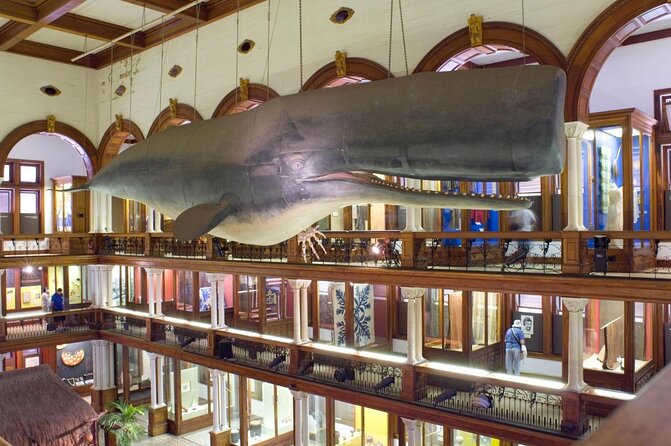
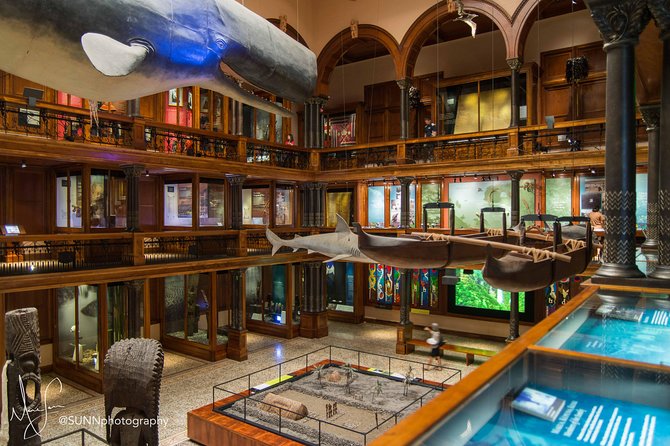
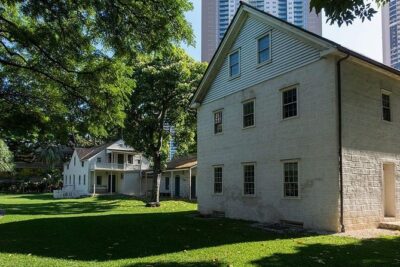
The museum was founded in 1889, and its age shows in the ornate buildings as much as in the collections. Beautiful woodwork and carefully arranged displays make the main museum worth seeing even if you are not the sort of person who reads every label.
I would not treat this as a quick indoor stop between other activities. The museum covers several buildings, and each one has a different purpose. You can move from Hawaiian history to Pacific migration, then to astronomy and volcanic science. That variety is its strength, but it also means you need a plan.
A visit can last from about one hour to eight hours. In practical terms, one hour lets you sample the main building. Two hours gives you a useful introduction. If Hawaiian and Polynesian culture matter to you, set aside at least half a day.
More Honolulu sightseeing tours:
- Pearl Harbor, USS Arizona Memorial & Honolulu City Tour
★ 5.0 · 4,866 reviews - Pearl Harbor City Tour
★ 5.0 · 4,254 reviews - Pearl Harbor, National Memorial Cemetery and Honolulu City Tour
★ 4.5 · 1,777 reviews
Hawaiian Hall: the best place to begin
Start with the Hawaiian Hall Complex. This is the museum’s central cultural experience and the place where you’ll find the clearest look at Hawaiian history, traditions, and material culture.
The displays include striking examples of featherwork, woven mats, fishing hooks, art, and objects connected with Hawaiian leaders. One especially memorable area is the room with feathered kahili, the traditional standards associated with Hawaiian royalty. The objects are beautiful, but the surrounding information helps you understand that they carried meaning and status, not just decoration.
You might also spend time with displays on the origins of the Hawaiian people. A large migration map helps show how populations moved across the Pacific and how Hawaiʻi fits into that much larger story. This is one of the museum’s most useful ideas: Hawaiian culture is specific to these islands, yet it is also part of a wide network of Pacific voyaging and settlement.
The building itself deserves attention. Its woodwork and formal design give the collection a fitting setting, and the architecture can be as memorable as individual objects. If you like history, photography, or traditional arts, this is where you’ll likely spend most of your time.
The main weakness is the amount of text. You can skim and still see the important objects, but careful reading takes hours. If someone in your party reads every label, let that person set the pace rather than trying to force the entire campus into a tight schedule.
Pacific Hall and the story of ocean migration
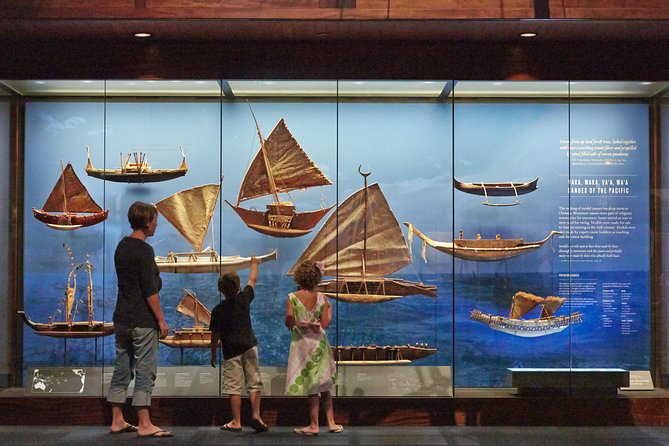
Pacific Hall shifts your attention from Hawaiʻi alone to the wider Pacific. Its displays explain the origins, cultures, values, migrations, and settlement of Pacific peoples.
This section matters because it helps correct a common vacation mistake: treating Polynesia as one single culture. The exhibits give you a broader frame for understanding how island societies developed and how ocean travel shaped their lives.
The large migration map is particularly helpful. It turns a subject that can feel abstract into something you can follow visually. You see Hawaiʻi as part of a major movement of people across the ocean, rather than an isolated dot on a modern map.
I like this section for a quieter reason too. It encourages you to look at familiar Pacific objects with more care. Fishing gear, woven materials, and navigational ideas are not simply craft items. They reveal how communities used local resources, passed skills between generations, and adapted to life on islands.
If your main interest is Hawaiian royalty, you may spend less time here. If you want to understand Polynesian connections and settlement, give Pacific Hall a proper visit rather than treating it as a passage between buildings.
The planetarium and Polynesian knowledge of the sky
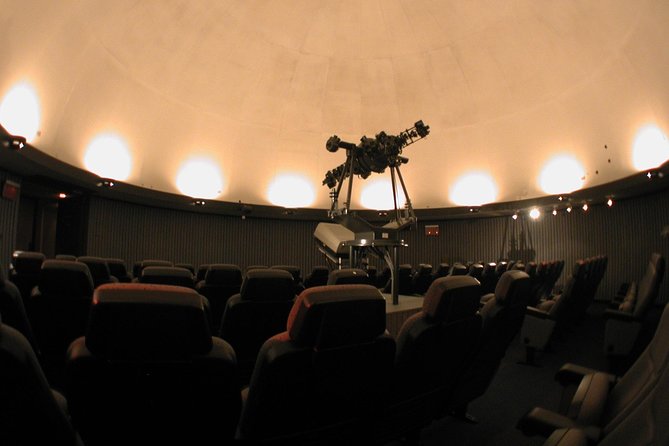
The Jhamandas Watumull Planetarium focuses on the skies of Hawaiʻi and Polynesia. Its programs connect astronomy with the ways ancient Pacific navigators read the heavens.
That subject gives the museum one of its most distinctive experiences. You are not looking at astronomy as a separate school topic. You are considering how stars helped people cross open ocean and maintain connections between widely separated islands.
The planetarium show is optional and costs extra, so admission alone does not guarantee a seat. Availability has also been uneven, with the planetarium sometimes closed. Check the current schedule before building your day around it.
When a navigation program is running, it can be a strong addition to the museum. It adds a sense of scale to the Pacific migration story and shows that traditional knowledge included careful observation, memory, and practical skill.
The waiting area has received criticism for needing improvement, so keep your expectations focused on the program itself rather than the surroundings. If the planetarium is closed, you can still get plenty from Hawaiian Hall and Pacific Hall, but the overall value changes if astronomy was your main reason for coming.
A few more Honolulu days out worth weighing up
- Pearl Harbor Aviation Museum Ticket with Audio Tour and Shuttle
★ 4.5 · 58 reviews - Honolulu: Bishop Museum General Admission Ticket
★ 4.7 · 20 reviews - Oahu: Pearl Harbor Aviation Museum Entry Ticket
★ 4.5 · 63 reviews - Deluxe Arizona Memorial and Pearl Harbor Aviation Museum Tour
★ 4.5 · 21 reviews
Science Adventure Center and the live lava program
The Richard T. Mamiya Science Adventure Center is the most family-friendly part of the campus. Its interactive displays focus on science as it relates to Hawaiʻi and Pacific environments.
The main themes include lava, volcanoes, and the formation of the Hawaiian Islands. Children who might lose patience in a long historical gallery have a better chance of staying engaged here, while adults can connect the demonstrations to the islands they are seeing outside the museum.
A live lava melting demonstration is advertised as part of the experience, but it is not guaranteed on every visit. Some feedback describes the demonstration not taking place, so ask about the day’s schedule when you arrive.
This building is also useful on a rainy day. You can spend time indoors with exhibits that explain a central fact of Hawaiʻi: the islands were built by volcanic activity. The science displays give physical meaning to the mountains, cliffs, and black-rock shorelines you may see elsewhere on Oʻahu.
For families, I would visit the science center after the main cultural buildings. That way, children get a hands-on change of pace after the more traditional displays. For adults without children, the building is still worthwhile, especially if volcanoes, geology, or environmental science interest you, but it may not hold you as long as Hawaiian Hall.
Castle Memorial Building and changing exhibits
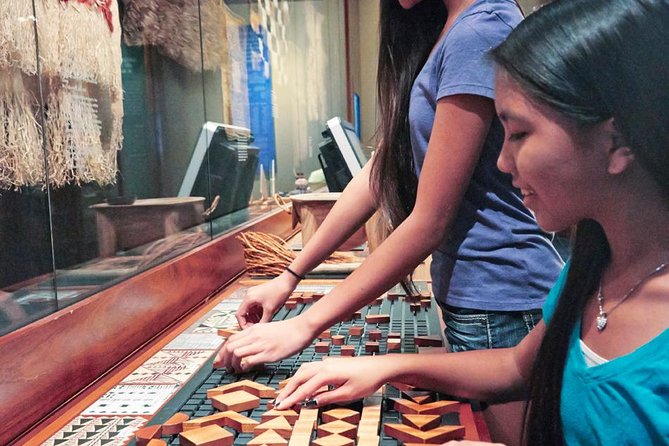
The Castle Memorial Building houses temporary exhibits. This gives the museum room for new subjects and limited-time displays, but it also means the content can change and the building may not always be open.
Do not make the Castle Memorial Building the main reason for buying your ticket unless you have confirmed what is showing. Its value depends on the current exhibit, and some visits have found little available there.
That said, changing exhibits can add variety to a return visit. If you have already seen the main Hawaiian and Pacific collections, a temporary display may give you a new reason to come back.
How much time should you allow?
The honest answer is longer than most people first expect. The campus is large, and moving among buildings takes time. The displays also reward different speeds: you can glance at objects, read selected labels, or examine nearly everything.
Use this guide:
- One hour: A quick look at Hawaiian Hall and the main architectural details.
- Two hours: A reasonable introduction to the principal museum displays, but not enough for a careful reading of everything.
- Four hours: Enough time for Hawaiian Hall, Pacific Hall, the science center, and perhaps the planetarium if a show is available.
- Half a day or more: The best choice if you want to read labels, attend a show, see temporary exhibits, and explore the grounds without hurrying.
- Up to eight hours: Suitable only for dedicated museum visitors who want to examine nearly every section at a slow pace.
Go early if you can. That gives you the best chance of seeing the buildings before closing and leaving time for food. One practical warning is that the restaurant may close before you finish exploring, especially if you arrive late in the day.
The museum works well during rainy weather, but dress for the conditions because the campus includes movement between buildings. You should also expect a moderate amount of walking and standing.
Is the $38.95 admission a good deal?
At $38.95 per person, general admission is not a casual bargain. The price makes more sense when you plan to spend at least half a day and use several parts of the campus.
The value is strongest for people who care about Hawaiian culture, Pacific history, traditional arts, science, or astronomy. A family may also get solid value from combining the cultural buildings with the interactive science center.
The value is weaker if you only have an hour, if you are mainly interested in the planetarium, or if several buildings and programs are unavailable. Planetarium admission, special exhibits, and parking are additional costs, so budget beyond the base ticket if those matter to you.
It is also smart to compare the online price with the museum’s own current admission offers. One reported visit found a much lower special-day price at the reception desk, while the prepaid ticket was nonrefundable for that date. Prices and promotions can change, but the lesson is simple: check before purchasing if you have a flexible schedule.
The ticket allows a mobile entry method, and confirmation is provided at booking. The museum is near public transportation, and service animals are allowed. Parking is optional and costs extra.
Who will enjoy Bishop Museum most?
I would recommend this museum to:
- Families with children who like interactive science exhibits.
- Couples who want more cultural context than a resort area provides.
- History fans who enjoy objects, architecture, and detailed labels.
- Anyone curious about Polynesian migration and ocean navigation.
- Visitors looking for a substantial indoor activity on a rainy day.
- Teenagers who prefer exploring at their own pace.
You may enjoy it less if you want a short, highly guided attraction with one central highlight. The museum asks you to choose your own route and spend time with displays. Younger children may find the historical sections slow, although the science center offers a better fit.
There is no named guide included with this admission. You explore independently, with the exhibits providing the explanations. That gives you freedom, but anyone wanting a tour-led visit should check whether a separate program is available.
Practical booking advice
The experience operates in all weather conditions, so dress appropriately and plan for walking between buildings. The stated policy also says the experience requires good weather, with a different date or full refund offered if it is canceled for poor weather. Since that wording can matter, check the day’s operating status before setting out.
Free cancellation is available until 24 hours before the start time. Inside that window, the payment is not refunded and changes are not accepted. Cutoff times use Honolulu local time.
The museum is often booked about 22 days ahead, which suggests that planning early can help during busy periods. Still, advance purchase is not automatically the best value if your date is flexible and the museum may have a lower direct price.
Should you book Bishop Museum?
Book it if you want to understand Hawaiʻi, not just photograph it. Hawaiian Hall and Pacific Hall provide the strongest reason to come, while the science center makes the visit easier to share with children. The planetarium can add an excellent connection between Polynesian navigation and the night sky, but treat it as an optional extra rather than a guarantee.
Give yourself at least half a day, arrive early, and check which buildings, demonstrations, and shows are operating. At $38.95, the ticket earns its keep when you explore several sections. If you have only two hours or expect every advertised feature to be open, compare prices and availability first.
FAQ
What does the Bishop Museum admission ticket include?
It includes general admission to Bishop Museum and access to its main museum areas, including Hawaiian Hall, Pacific Hall, the Richard T. Mamiya Science Adventure Center, and available areas of the Castle Memorial Building.
Is the planetarium included in admission?
No. The planetarium show is optional and costs extra. Availability can also change, so check the current schedule before you visit.
How long should I plan for Bishop Museum?
The visit can take about one to eight hours. Allow two hours for a quick introduction, but plan at least half a day if you want to explore the main buildings carefully.
Is the live lava demonstration included?
The science center features a live lava melting show, but the demonstration may not operate on every visit. Ask about the schedule when you arrive.
Is parking included?
No. Parking fees are optional and are not included in the admission ticket.
Are special exhibits included?
Special exhibit fees are not included. The Castle Memorial Building presents changing exhibits, and availability depends on what is showing.
Is Bishop Museum suitable for children?
Yes, especially the Richard T. Mamiya Science Adventure Center, which offers interactive exhibits about lava, volcanoes, and Hawaiian science. Younger children may find the text-heavy historical areas less engaging.
Is the museum accessible by public transportation?
The museum is near public transportation. Service animals are allowed, and visitors should expect a moderate level of physical activity.
What is the cancellation policy?
You can cancel at least 24 hours before the experience start time for a full refund. Cancellations or changes made less than 24 hours in advance are not accepted for a refund.
Just added around Honolulu
- Kevo’s Beach Bus★ 5.0 · 3 reviews
- Private “Limousine” USS Arizona Memorial & Cultural Honolulu Tour★ 5.0 · 3 reviews
- Arrival Lei Greeting –HNL to Waikiki Private Transfer★ 5.0 · 3 reviews
- Private Full-Day Circle Island Guided Small-Group up to 6 (Se habla Español)★ 5.0 · 3 reviews
- Waikiki: Sunset Swim & Sailing Experience★ 4.5 · 3 reviews
- Private Customizable Grand Circle Island Tour on Oahu★ 5.0 · 3 reviews
- Oahu : Hanauma Bay Reservation+Equipment Rental★ 3.3 · 3 reviews
- Pearl Harbor USS Arizona & Bowfin Submarine★ 4.5 · 3 reviews
Honolulu City Tours, compared.
Pearl Harbor, USS Arizona Memorial & Honolulu City Tour
Read our review →
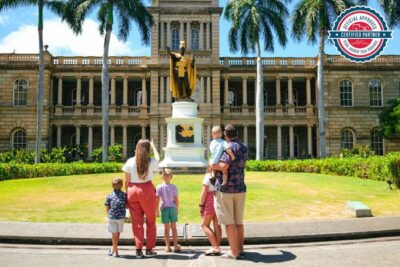
Pearl Harbor, National Memorial Cemetery and Honolulu City Tour
Read our review →
Pearl Harbor, Arizona Memorial & Honolulu City Tour
Read our review →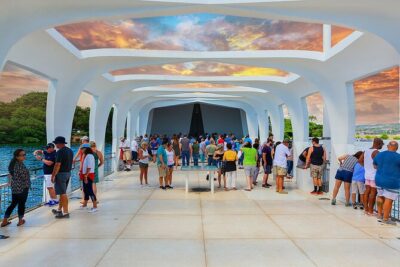
Tribute to Pearl Harbor Arizona Memorial and Honolulu City Tour
Read our review →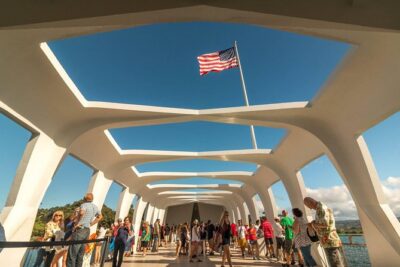
Deluxe Pearl Harbor USS Arizona Memorial and Honolulu City Tour
Read our review →Browse the lists this tour appears in