
Reviewed · WALKING TOURS
Honolulu Historic District a Smartphone Audio Walking Tour
Honolulu’s past is packed into a walkable downtown route, and this self-guided audio tour gives you the stories without tying you to a group or a fixed departure. You begin at Aliʻiolani Hale and pass royal landmarks, churches, museums, government buildings, theaters, and public art. The commentary even uses voiced historical stories, which adds a little drama to the walk.
I like two things right away. First, the $10.99 price is hard to beat for a private activity you can keep and use at any time. Second, the GPS map lets you pause, wander, or skip a stop when the sun gets strong. The main catch is important: this is an outdoor walking tour only. It does not include admission to Iolani Palace or any other attraction, and the audio can be quiet without earbuds.
In This Review
- Key points to know before you walk
- Begin with Hawaii’s royal and civic center
- Libraries, churches, and the people who shaped Honolulu
- Public art with stories behind the odd shapes
- The Bell of Nagasaki and Honolulu’s ties to Japan
- The State Capitol and a royal home
- Churches, gardens, and the memory of Queen Emma
- Downtown shopping streets and the Hawaii Theatre
- How the phone tour works on the street
- Timing, heat, and the real length of the walk
- Is $10.99 good value?
- Who should book this Honolulu walk?
- FAQ
- Where does the Honolulu Historic District audio tour start?
- Where does the tour finish?
- How long does the walking tour take?
- Do I need mobile data during the tour?
- Is the tour led by a live guide?
- Are attraction entrance tickets included?
- What language is available?
- Can I cancel for a full refund?
Key points to know before you walk
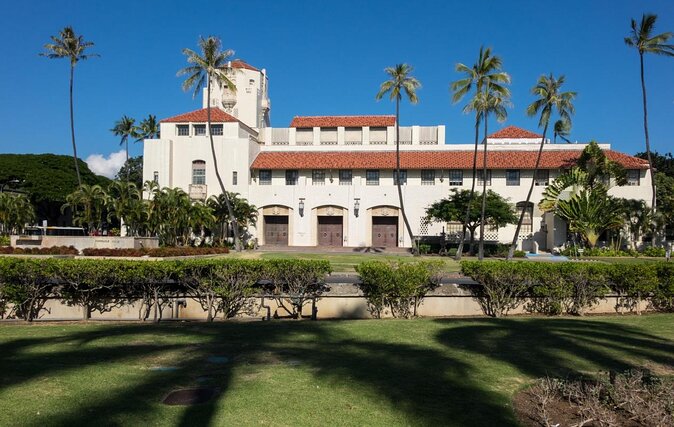
- Start at Aliʻiolani Hale: The route begins at 417 S King Street and returns to the same meeting point.
- Twenty-six points of interest: You’ll hear about Hawaiian royalty, civic buildings, churches, theaters, libraries, statues, and memorials.
- No phone signal needed: Download the tour over Wi-Fi before setting out. The live GPS route then works without using mobile data.
- Flexible timing: The stated duration is one to two hours, but you can take longer, pause, or continue another day.
- Bring earbuds: Audio plays through your phone speaker, but some commentary may be hard to hear in downtown Honolulu.
- Outdoor access only: Attraction tickets are not included, so plan separately if you want to enter a palace, museum, church, or theater.
Begin with Hawaii’s royal and civic center
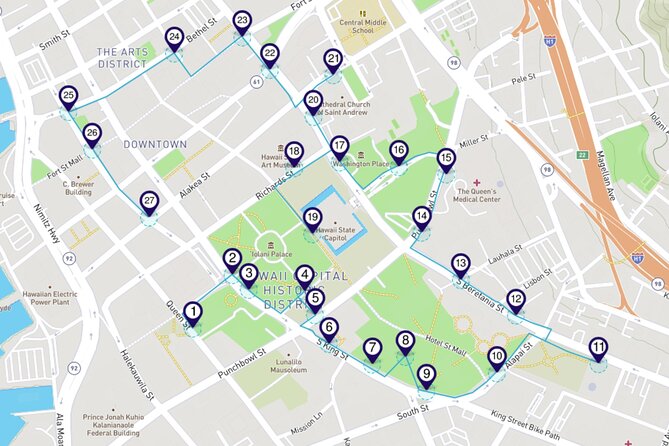
Your walk starts outside Aliʻiolani Hale, the handsome government building whose name means House of the Heavenly Kings. This is a strong opening because it places you in the middle of Honolulu’s old political center rather than dropping you into a broad, unfocused city walk.
The tour explains how the building was constructed in 1879 for King Kalakaua, ruler of the Hawaiian Kingdom. You’ll also hear the story behind the nearby statue of King Kamehameha I, Hawaii’s most celebrated monarch. The statue gives the royal material a clear focal point, and the folklore tied to Kamehameha adds more personality than a simple date-and-name narration would.
This first stretch should appeal to you if you want context before visiting Honolulu’s major sites. It also helps you understand what you are looking at from the street. Just remember that the tour does not provide entry into the buildings. You are viewing them from outside and listening to their stories.
The Kanaina Building follows, with its Victorian design and place on the National Register of Historic Places since 1978. The route also introduces Patsy Mink and explains the achievements that led to her statue. Her inclusion broadens the walk beyond monarchs and royal families, bringing in a major figure from modern Hawaii and American public life.
A few more Oahu days out worth weighing up
- Oahu: Mauka Warriors Luau Honoring Polynesia’s Forgotten History
★ 5.0 · 3,013 reviews - Pearl Harbor History Remembered Tour from Ko Olina
★ 5.0 · 1,009 reviews - Pearl Harbor with USS Arizona and Hawaiian Kingdom History Tour
★ 4.5 · 184 reviews
Libraries, churches, and the people who shaped Honolulu
One stop takes you to a library that began as a simple reading room in 1879. Its original purpose was practical: keeping unruly sailors occupied. That small detail makes the building easier to remember, and it shows how civic institutions often began with very ordinary needs.
The tour then turns to Hawaii’s oldest church. This section gives you a look at the role of Christian institutions in the islands and how closely religion, royal life, and government were once linked. The route also explains why King Lunalilo refused burial in the Royal Mausoleum and instead rests at the church.
That story is one of the more personal stops on the walk. It moves the experience away from grand buildings and into questions of identity, choice, and royal custom. I like this kind of detail because it gives you a reason to stop and look, rather than simply telling you that a building is old.
You’ll also pass Honolulu’s city hall, where the commentary points out its special construction features. Another nearby building raises a puzzle about the years 1820 and 1915 engraved on its front, even though the building itself dates to 1921. The audio explains the difference, turning what might look like a random inscription into a small piece of local history.
Public art with stories behind the odd shapes
Not every stop is a grand landmark. One is an unusual sculpture linked to a natural phenomenon. The tour explains why the work looks so strange, giving you a reason to pay attention to public art that you might otherwise walk past.
Another stop is the Frank F. Fasi Building, Honolulu’s municipal building since 2006. Its design is intentionally distinctive, and the commentary explains the thinking behind it. This is useful for anyone who enjoys architecture but does not want a technical lecture. You get the basic idea, then move on before the details become heavy.
On the grounds of Seagull Schools, you’ll find relaxed-looking stone figures. The setting is an early childhood education center, and the audio explains the connection between the sculptures and the site. This is a good reminder that downtown Honolulu is not just a collection of official buildings. Schools, public spaces, and works of art also tell part of the city’s story.
The tour continues to the Honolulu Police Department, where you’ll hear about something unusual connected with the department and its building. The supplied information does not identify the feature in detail, so expect the app to provide the explanation when you reach the stop.
The Bell of Nagasaki and Honolulu’s ties to Japan
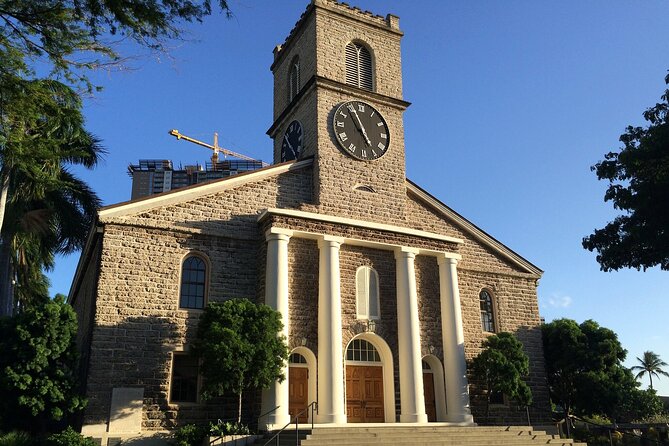
The Bell of Nagasaki is described as a symbol of peace and friendship between the United States and Japan. That makes it one of the route’s most meaningful memorial stops, especially because its message is simple and easy to grasp while you stand beside it.
The walk does not treat Honolulu as an isolated island capital. Instead, it points to the city’s connections across the Pacific. That wider view gives the route more range than a tour focused only on Hawaiian royalty and American government.
You’ll also visit the Queen’s Conference Center, a historic and cultural landmark. The tour then explains a major complex created through the vision of Queen Emma and King Kamehameha IV. Their plans for Hawaii come into focus here, linking architecture with public service and royal responsibility.
I find this portion especially useful if you are interested in how royal figures are remembered through institutions, not only statues and palaces. The route shows how their influence reached hospitals, public buildings, religion, and education.
More walking tours around Oahu:
- Self guided Hike Trail to Nature Walk & Waterfall
★ 4.5 · 283 reviews - Honolulu Haunts: Ghosts and Spirits Walking Tour
★ 4.2 · 169 reviews - Honolulu Downtown Walking Tour
★ 5.0 · 149 reviews - Kualoa Ranch – Horseback Walking Tour
★ 4.0 · 145 reviews
The State Capitol and a royal home

The Hawaii State Capitol became the official state capitol in 1969. The audio gives you the building’s background and helps you read its place in Hawaii’s modern political story.
You then reach a regal manor built in 1842 by a clipper ship captain for his wife and young son. The house has its own unusual tale, and its presence adds a domestic note to a walk otherwise filled with public institutions. It is a useful contrast: one stop shows the machinery of government, while the next suggests how private households fit into Honolulu’s earlier society.
Another stop is a museum devoted to Hawaiian art and culture. The tour presents it as an important destination for anyone interested in island traditions. Since admission is not included, you’ll need to decide if you want to return and go inside separately. The audio still helps you understand why the museum matters before you make that choice.
The route also recalls the last surviving member of the Kamehameha dynasty. Hearing the story in the voice of the Queen gives this part an added theatrical touch. One of the tour’s best features is its use of voiced historical figures and dramatic storytelling. It is not the same as having a live guide answer questions, but it can make familiar names easier to remember.
Churches, gardens, and the memory of Queen Emma

The walk visits another impressive place of worship connected to a dream shared by King Kamehameha and Queen Emma for Hawaii. The stop adds a spiritual and architectural layer to the royal story, while also showing how much of Honolulu’s public life was shaped by their plans.
A small area once named for Queen Emma now also honors James and Abigail Campbell, a change made in 2016. This is a modest stop, but it reflects the way public places evolve as a city decides whom to remember.
You’ll get the most from these stops if you let the audio run while you look closely at the buildings and surrounding spaces. A self-guided route works best when you give each place a few quiet minutes. If you rush from marker to marker, the experience can become a list of names.
Downtown shopping streets and the Hawaii Theatre

The pedestrian-only street mall was created in the 1960s as part of an effort to revive downtown Honolulu. Today, it remains linked with shopping, dining, and entertainment. This part of the route shifts the focus from royal Honolulu to the city as people use it in everyday life.
The Hawaii Theatre Center opened in 1922 during the age of vaudeville and silent film. Its story gives you a glimpse of Honolulu as a Pacific entertainment center, not just a seat of government.
The route also visits a building donated to the Kumu Kahua Theatre Company. The company was formed to produce new works by Hawaii playwrights and plays that reflect the many cultures and experiences of the islands. That makes this stop particularly worthwhile for you if you want to see how Hawaii’s identity is expressed by local artists today.
The tour ends with an explanation of an unusual building material. People looking for a substitute for the bricks familiar to newcomers chose a local solution, and the audio tells you what it was. It is a small, practical detail, but these are often the facts that stay with you after the walk.
The itinerary has a good spread of subjects: royal figures, civic architecture, memorials, theaters, churches, art, and local culture. Some stops will matter more to you than others. The advantage of the app is that you can keep moving when a building does not catch your interest.
How the phone tour works on the street

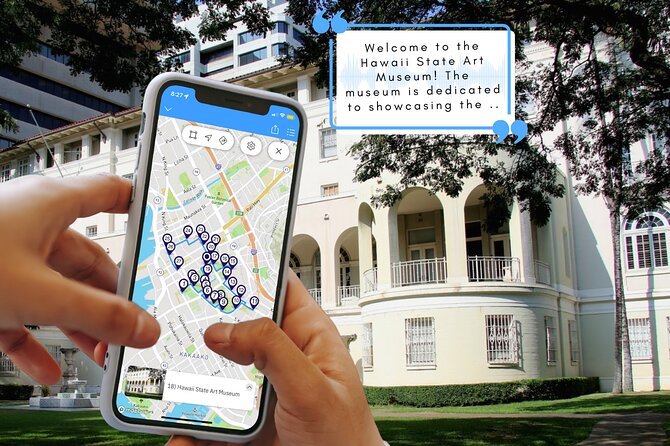
You need your own smartphone or tablet. Download the tour over Wi-Fi before leaving, and you will not need a signal or mobile data during the walk. A live GPS map shows the route and your location, while the commentary starts automatically at each point of interest.
That setup is simple, but it has practical limits. GPS audio can feel less personal than a live guide, and you cannot ask follow-up questions. On the other hand, you are not waiting for a group, keeping pace with strangers, or trying to hear a guide over city noise.
Bring earbuds. Audio can play through your phone speaker, but one person found some of the narration too quiet without them. Earbuds also let you listen near busy streets without turning the volume too high.
The tour is offered in English only. Service animals are allowed, it is near public transportation, and most people can take part. This is a private activity in the sense that only your group uses the tour, but there is no live guide accompanying you.
Timing, heat, and the real length of the walk
The advertised duration is about one to two hours. In practice, your pace, photo stops, pauses, and interest in the buildings can stretch the outing. One useful tip is to start early. Honolulu’s heat and sun can make a downtown walk tiring, and an early morning start gives you a more comfortable window.
The route is available any day from midnight to 11:30 p.m., and you can use it whenever you choose during the operating period listed for the experience. There is no deadline once you have the tour. You can take a break and continue later, or save it for another day.
The route starts and ends at Aliʻiolani Hale, 417 S King Street, Honolulu. A helpful extension is Chinatown, which is not part of the listed route but can make a natural addition at the end if you want more time on foot in central Honolulu.
Is $10.99 good value?
At $10.99 per person, this is a low-cost way to spend an afternoon in downtown Honolulu. You are paying for the route, GPS functions, recorded commentary, flexible use, and customer help by phone and email. You are not paying for attraction admission, transportation, headphones, or a device.
That distinction matters. If you want to enter a palace or museum, this tour will not replace an on-site ticket. One booking mistake came from expecting palace access and an indoor audio tour. If entry is your priority, buy the attraction’s own ticket separately. This experience is best viewed as an outdoor introduction to the district.
The price works well for independent visitors, couples, families who want to move at their own pace, and repeat visitors looking for a short cultural outing. It is less suitable if you want a live historian, personal conversation, or a tightly managed group walk.
Free cancellation is available when you cancel at least 24 hours before the start time. Within 24 hours, the payment is not refunded, and late changes are not accepted.
Who should book this Honolulu walk?
I would choose this tour if you want a low-cost orientation to Honolulu’s capital district and enjoy learning in small pieces. It suits you especially well if you already have a phone, prefer flexible schedules, and do not need indoor admission included.
It also works for a first afternoon in the city, when you want to understand the buildings before deciding which ones deserve a longer visit. Start early, download the audio on Wi-Fi, and bring earbuds.
I would skip it if your main goal is to tour Iolani Palace or another attraction from the inside. You should also think twice if you dislike listening to recorded narration or want a guide who can respond to questions. For everyone else, the tour offers a useful set of stories at a modest price, with the freedom to shape the walk yourself.
FAQ
Where does the Honolulu Historic District audio tour start?
It starts at Aliʻiolani Hale, 417 S King Street, Honolulu, Hawaii 96813.
Where does the tour finish?
The activity ends back at the starting point, Aliʻiolani Hale.
How long does the walking tour take?
The estimated duration is one to two hours, but there are no time constraints. You can take longer or pause as needed.
Do I need mobile data during the tour?
No. Download the tour over Wi-Fi before you begin. The tour is designed to work without a signal or mobile data during the walk.
Is the tour led by a live guide?
No. It is a smartphone audio tour with automatic commentary at each point of interest and a live GPS map showing your route and location.
Are attraction entrance tickets included?
No. Attraction tickets are not included, and the tour is an outdoor walking experience. You cannot assume that it provides entry to a palace, museum, church, or other building.
What language is available?
The tour is offered in English.
Can I cancel for a full refund?
Yes, if you cancel at least 24 hours before the experience’s start time. Cancellations made less than 24 hours before the start time are not refunded.
More Self Guided and Audio Tours
- Chief’s Official Pearl Harbor Self-Guided Multimedia Tour
★ 4.0 · 407 reviews - Self-Guided Kayaking Discovery in Kailua, Oahu
★ 5.0 · 249 reviews - Manoa Falls Rainforest & Self-Guided Hike
★ 4.5 · 227 reviews - Diamond Head Official Self-Guided Narrated Audio Tour
★ 3.0 · 212 reviews
Just added around Oahu
- Kevo’s Beach Bus★ 5.0 · 3 reviews
- 2hr Luxury Private Sailing Catamaran for 7-12 People★ 5.0 · 3 reviews
- Mokulua Islands Self-Guided Kayak Adventure★ 3.5 · 3 reviews
- Night Ninja Adventure Course in Kapolei★ 3.5 · 3 reviews
- Arrival Lei Greeting –HNL to Waikiki Private Transfer★ 5.0 · 3 reviews
- Private “Limousine” USS Arizona Memorial & Cultural Honolulu Tour★ 5.0 · 3 reviews
- Surf Lessons get your Social Media video & photos you Surfing HI.★ 5.0 · 3 reviews
- (2nd)Diamond Head Hike w/ Malasada Starts at 7:00 a.m.★ 3.3 · 3 reviews
Walking Tours, compared.

Self guided Hike Trail to Nature Walk & Waterfall
Read our review →
Honolulu Haunts: Ghosts and Spirits Walking Tour
Read our review →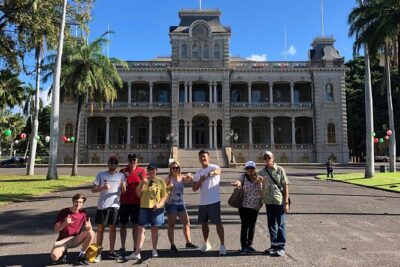




Browse the lists this tour appears in