Reviewed · PRIVATE
Private Efoil Experience in Ke’ehi Lagoon
The most surprising part of this eFoil lesson is how quickly the board can move from ordinary watercraft to something that seems to hover. You start on your belly, progress to your knees, then learn to stand and lift the hydrofoil above the water. I like the clear step-by-step format, and I like that guide Ben uses helmet radios so you can still hear useful coaching once you move away from him. The setting at Ke’ehi Lagoon also gives beginners a calmer place to learn than a crowded surf break.
The main catch is the amount of actual riding time. A two-hour booking includes only about 30 minutes of water time per student, split into three 10-minute runs, plus 15 to 30 minutes of instruction on land. That is enough for a first lesson, but you should not confuse it with two straight hours on the board. The standard lesson also requires at least two students, and one eFoil is shared by every two students.
In This Review
- Key Points Before You Book
- What eFoiling Feels Like at Ke’ehi Lagoon
- The 15 to 30 Minute Land Lesson
- Run One: Belly Riding and Remote Control
- Run Two: Kneeling and Touch and Go Foiling
- Run Three: Standing, E-Surfing, and the First Flight
- How the Two-Hour Schedule Really Works
- Ben, Jason, and the Coaching Style
- Price, Extra Costs, and Overall Value
- Who Will Enjoy This Most
- Booking Details, Weather, and What to Clarify
- Should You Book the Ke’ehi Lagoon Efoil Lesson?
- FAQ
- Where does the eFoil experience meet?
- Where does the activity end?
- How long does the experience last?
- How much water time does each student receive?
- How much land instruction is included?
- Do I need surfing experience?
- What age do I need to be?
- How many students are required to book?
- Is transportation included?
- What happens if bad weather cancels the lesson?
Key Points Before You Book
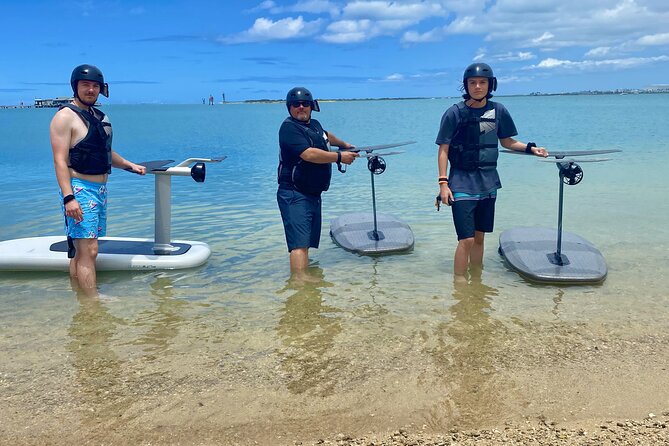
- You learn three riding positions: belly down, kneeling, and standing, with the hydrofoil coming last.
- The lesson uses a balance-board simulator: You practice center-of-gravity control before handling the real board.
- Ben is a key part of the experience: His coaching is described as clear, efficient, patient, and easy to follow.
- Water time is carefully divided: Each student gets three 10-minute runs, for about 30 minutes total.
- No surf background is required: Board sports such as skateboarding, wakeboarding, or kneeboarding may help with balance.
- Extra charges can affect the price: Photos cost $39, and students over 205 pounds pay an additional $49 Big and Tall charge.
What eFoiling Feels Like at Ke’ehi Lagoon
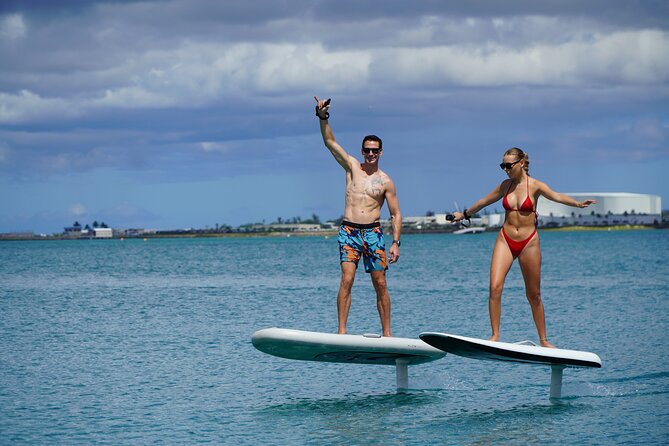
An eFoil is a surf-style board powered by a battery and handheld remote. Under the board sits a hydrofoil, a wing-shaped fin that creates lift as you gain speed. At first, the board behaves much like a powered surfboard. As your balance improves, the foil rises and the board begins to glide above the surface.
That change is the thrill. You are not waiting for a wave, paddling into white water, or fighting for a place in a crowded surf lineup. The motor supplies the forward movement, while your body position controls the board. You may spend the early part of the lesson simply learning to keep the board pointed in the right direction, then suddenly feel it skim free of the water.
Ke’ehi Lagoon is used as the riding area, and the experience is designed around learning rather than showing off. That matters because eFoiling looks simple from shore but requires small, steady movements. Lean too far forward and the board drops. Shift too far back and the nose can rise sharply. A patient lesson gives you room to build those reactions one at a time.
The activity is aimed at people age 13 and older. You do not need to know how to surf, but basic balance from skateboarding, wakeboarding, kneeboarding, or similar activities can help. If you have never stood on a board before, expect a learning curve, even though the progression is friendly to first-timers.
More private tours on Oahu:
- Turtle Canyon Snorkel: Semi Private Boat Tour
★ 5.0 · 710 reviews - Honolulu Airport, Cruise Port and Hotels Private Transfer
★ 5.0 · 452 reviews - Honolulu Airport: Waikiki Private Transfer With Lei Greeting
★ 5.0 · 339 reviews
The 15 to 30 Minute Land Lesson
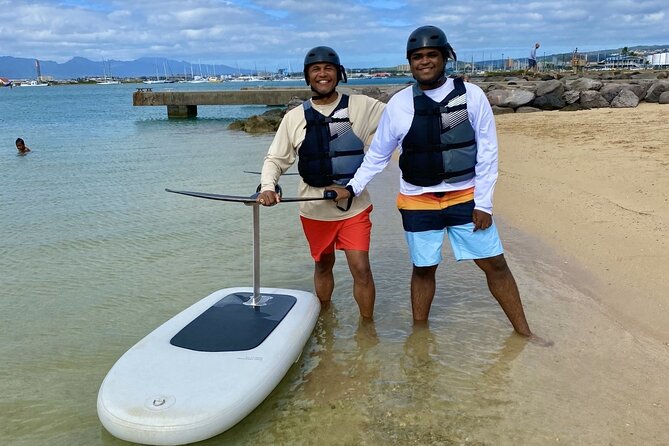
Your first formal step is a safety and comprehension lesson on land. This is not filler. You learn how the remote works, how to control speed, and how to shift your center of gravity before you are placed on moving water.
The balance-board eFoil Simulator is especially useful. It lets you rehearse the three positions used during the lesson: lying on your belly, kneeling, and standing. You get a chance to feel how small changes in body position affect the board without also worrying about the motor, the lagoon, and the foil beneath you.
The guide also covers safety equipment and basic handling. The exact length of the land portion varies from 15 to 30 minutes, which is sensible because some people need more explanation than others. The best approach is to listen closely here. Every minute spent learning the remote and body position on land saves confusion during your short water runs.
The instructors’ communication is one of the strongest practical features. Helmets with radios allow Ben to give corrections while you ride away from him. That means you do not have to keep returning to shore or shouting across the water to ask what went wrong.
Run One: Belly Riding and Remote Control
The first water run begins on your belly. This may sound less exciting than standing, but it gives you the essential foundation: controlling the remote, steering the board, and keeping a steady direction.
At this stage, you are learning to make the board respond without the added problem of standing balance. You may practice turning and getting comfortable with the motor’s thrust. The goal is control, not height. If you can keep the board moving in a predictable line, you have already made useful progress.
The first run is also where you learn how the eFoil feels under power. Unlike a regular surfboard, it does not need a wave to move. Unlike a small motorboat, it responds to your body and board angle. That combination can feel unfamiliar at first.
I would resist the temptation to rush toward standing. The lesson works best when you treat belly riding as a real skill, not an obstacle. A stable belly position gives you a better sense of the remote and makes the later kneeling stage less hectic.
Run Two: Kneeling and Touch and Go Foiling
The next progression is kneeling. Here you begin to use more balance while still keeping a low center of gravity. The instructor can help you find a stable position and begin experimenting with short moments of lift.
This stage is often called touch and go foiling. The board rises slightly, then settles back onto the water. Those brief lifts teach you what the correct pressure feels like. You start to notice the sweet spot between moving fast enough for the foil to lift and staying low enough to remain in control.
The kneeling position is valuable because it links the simple mechanics of belly riding with the more demanding standing position. You will likely practice turns, throttle control, and short attempts at rising. If you lose balance, you are already close to the board, which makes this a less intimidating way to learn.
Several first-time riders have reached a standing or airborne stage within roughly 30 to 60 minutes of instruction. That is an encouraging target, not a promise you should treat as a guarantee. Body balance, comfort on boards, and how quickly you absorb the guide’s corrections all matter.
A different sort of day, same island:
- Oahu Grand Circle Island and Haleiwa Tour: 9-Hr Deluxe Experience
★ 5.0 · 17,387 reviews - Oahu: Grand Tour Around Island 16 Locations plus Snorkeling
★ 5.0 · 8,669 reviews - Parasailing Experience in Waikiki, HI
★ 5.0 · 7,692 reviews - Salute to Pearl Harbor Including USS Arizona
★ 4.5 · 7,433 reviews
Run Three: Standing, E-Surfing, and the First Flight
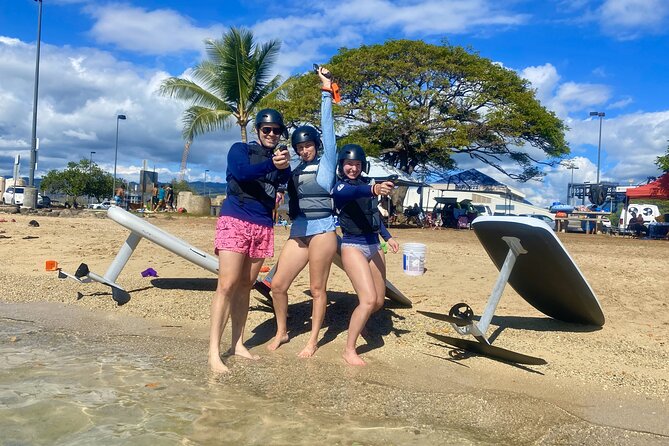
The final stage begins with a pop-up from your knees to standing. Once upright, you work on ordinary powered riding before trying to lift the foil fully. This is sometimes called e-surfing, and it is an important middle step.
Standing changes everything. Your weight is higher, your movements become more noticeable, and the board can react quickly. The guide helps you master turns and maintain a stable line before encouraging you to rise above the water.
The first sustained flight may happen in short bursts. You feel the board lift, correct your balance, touch down, and try again. Once you can manage those touch-and-go moments, the instructor moves you toward longer rides.
This is where the experience earns its sense of wonder. The board becomes quieter and smoother as the foil lifts it clear of the surface. You are no longer bouncing across the water in the usual way. You are gliding above it, guided by the remote and your own balance.
The lesson plan wisely emphasizes learning at your own speed. Some people may stand quickly but need more time to control turns. Others may spend most of the session kneeling and still leave with a good understanding of how to continue. A successful first lesson does not have to mean a long flight.
How the Two-Hour Schedule Really Works
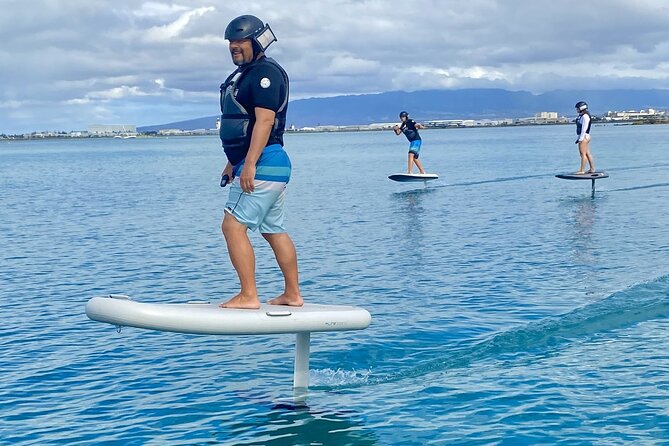
The booking lasts about two hours, but the schedule is not two hours of uninterrupted riding. The land lesson takes 15 to 30 minutes, and each student receives about 30 minutes of water time. That water time is divided into three separate 10-minute runs.
This split has a few benefits. You get a chance to rest, listen to feedback, and watch the other rider before your next turn. EFoiling demands concentration, and short runs can keep beginners from tiring too quickly.
The limitation is obvious: you will spend part of the session waiting while the other student rides. One eFoil is provided for every two students. If you are booking with a friend or family member, this creates a shared lesson. If you want more riding time or less waiting, ask about adding students or arranging a customized semi-private format before you book.
The information describes the activity as private, with only your group participating, while also requiring a minimum of two students and sharing one board between two people. I would confirm the exact group setup with Efoil Waikiki when booking, especially if your party has more than two people or if you are expecting a one-board-per-person lesson.
Ben, Jason, and the Coaching Style
Ben is the instructor most closely associated with the experience. His teaching style is direct and practical. He is described as clear with instructions, efficient with time, patient with beginners, and good at giving corrections while you are riding.
That matters in eFoiling because vague advice is not much help when the board is moving beneath you. You need short guidance such as shifting your weight, controlling the remote, or holding a turn. The radio helmet makes this possible even after you have moved away from the instructor.
Jason is also mentioned as part of the equipment and instruction team for some sessions. If having a particular instructor matters to you, ask when you make the reservation. The strongest pattern in the available feedback is not simply that the activity is fun, but that the instruction gets people moving quickly without making the lesson feel rushed.
You should still arrive ready to listen. The board can look easy once an experienced rider is flying, but your first few minutes will depend more on balance and controlled movements than on bravery.
Price, Extra Costs, and Overall Value
The listed price is $188. That is not a casual beach rental, but this is also not a simple hour of equipment hire. The fee includes a certified guide, safety equipment, land instruction, a balance-board practice session, remote-control coaching, and supervised water time.
For a first try at eFoiling, the guided format has real value. An instructor can explain the controls, watch your posture, and help you avoid wasting the entire session on trial and error. The radio communication is another practical advantage because it keeps the lesson moving.
The value is weaker if you measure the price only by minutes on the water. You receive about 30 minutes of water time per student, not 120 minutes. The price makes the most sense if your goal is to learn the basics in a structured setting, not simply ride for as long as possible.
Keep two added charges in mind. Photos are available for $39, and students over 205 pounds pay an additional $49 Big and Tall charge. If you are near that weight threshold, ask about the surcharge before finalizing your plans.
Who Will Enjoy This Most
I would recommend this for teenagers and adults who want a new water activity but do not want to begin with traditional surfing. The motor means you do not need waves, and the teaching plan gives you a clear route from lying down to standing.
It also suits people with board-sport experience. A skateboarder or wakeboarder may recognize the need to keep a soft stance and make small balance corrections. That background is helpful, but it is not required.
Families with teenagers can make this a memorable shared activity, provided everyone meets the minimum age of 13 and understands that the board may be shared. Couples and friends should be comfortable taking turns.
This may not suit you if you want a quiet sightseeing outing, dislike repeated falls, or expect constant riding. Even a beginner-friendly lesson involves balance, focus, and some physical effort. The experience is active rather than relaxing.
Booking Details, Weather, and What to Clarify
The listed meeting point is Hawaii Efoil Experience at 1216 Akumu Street, Kailua, Hawaii 96734. The activity ends back at the meeting point, and private transportation is not included. The listing notes access near public transportation, but you are responsible for getting to the start.
Confirmation is normally provided at booking. If you reserve within one day of the activity, confirmation arrives as soon as possible and depends on availability. Service animals are allowed, and most people can participate, though the activity is still physically active and requires a minimum age of 13.
The experience depends on good weather. If poor weather forces a cancellation, you are offered another date or a full refund. You can cancel for a full refund up to 24 hours before the local start time. Cancellations or changes made within 24 hours are not refunded or accepted.
Before paying, I would confirm three points: the exact meeting instructions for Ke’ehi Lagoon, how many people will share each board, and whether your preferred instructor will be Ben or Jason. Those questions are especially useful for families and groups.
Should You Book the Ke’ehi Lagoon Efoil Lesson?
Book it if you want to try eFoiling with a real instructor and you value a clear progression over maximum ride time. Ben’s focused coaching, the radio helmets, and the three-stage lesson give you a fair chance to reach kneeling, standing, or even short flights during your first session.
Think twice if $188 feels high for about 30 minutes of water time, or if you want a private board for every person. The shared-board format can mean waiting, and the added photo or Big and Tall fees raise the total.
For most first-timers age 13 and up, this is a strong introduction to a strange and exciting sport. Go in expecting instruction, not a two-hour free ride, and you will have a much clearer idea of what you are paying for.
FAQ
Where does the eFoil experience meet?
It meets at Hawaii Efoil Experience, 1216 Akumu Street, Kailua, HI 96734, USA.
Where does the activity end?
The activity ends back at the meeting point.
How long does the experience last?
The experience lasts approximately two hours.
How much water time does each student receive?
Each student receives about 30 minutes of water time, divided into three 10-minute runs.
How much land instruction is included?
The lesson includes 15 to 30 minutes of ground school and safety instruction.
Do I need surfing experience?
No. Surf experience is not required, although board-sport balance from activities such as skateboarding, wakeboarding, or kneeboarding may help.
What age do I need to be?
Students must be at least 13 years old.
How many students are required to book?
A minimum of two students is required to book the standard eFoil group lesson.
Is transportation included?
No. Private transportation is not included, so you must arrange your own way to the meeting point.
What happens if bad weather cancels the lesson?
If poor weather causes a cancellation, you are offered a different date or a full refund. For your own cancellation, you must cancel at least 24 hours before the start time for a full refund.
Just added around Oahu
- Kevo’s Beach Bus★ 5.0 · 3 reviews
- 2hr Luxury Private Sailing Catamaran for 7-12 People★ 5.0 · 3 reviews
- Mokulua Islands Self-Guided Kayak Adventure★ 3.5 · 3 reviews
- Night Ninja Adventure Course in Kapolei★ 3.5 · 3 reviews
- Surf Lessons get your Social Media video & photos you Surfing HI.★ 5.0 · 3 reviews
- Arrival Lei Greeting –HNL to Waikiki Private Transfer★ 5.0 · 3 reviews
- Private “Limousine” USS Arizona Memorial & Cultural Honolulu Tour★ 5.0 · 3 reviews
- (2nd)Diamond Head Hike w/ Malasada Starts at 7:00 a.m.★ 3.3 · 3 reviews
Private, compared.

Honolulu Airport, Cruise Port and Hotels Private Transfer
Read our review →
Honolulu Airport: Waikiki Private Transfer With Lei Greeting
Read our review →

Private Customizable Grand Circle Island Tour of Oahu
Read our review →
Family, Private & Group Surfing Lessons, Waikiki Courtesy Shuttle
Read our review →