
Reviewed · CYCLING TOURS
“Tour de Honolulu” Foodie Bike Tour
Honolulu makes more sense from a bicycle seat, especially when your route links local food with Hawaiian history. This private afternoon ride begins at Kuhio Beach, moves beyond Waikiki, and uses short stops at places such as Iolani Palace, Kakaʻako, and Ala Moana Beach Park to show you a broader slice of Oahu.
I like the personal format and the chance to eat where Honolulu residents eat, rather than spending the whole afternoon in the resort district. I also like the practical setup: your bicycle, helmet, bottled water, and guide are included. The main consideration is physical effort. Four and a half hours on a bike, with food stops and city riding, calls for a moderate fitness level.
In This Review
- Key points to know
- A four-and-a-half-hour ride beyond Waikiki
- The Ala Wai Canal gives the ride its Waikiki frame
- Elvis, the Blaisdell Center, and a slice of modern Honolulu
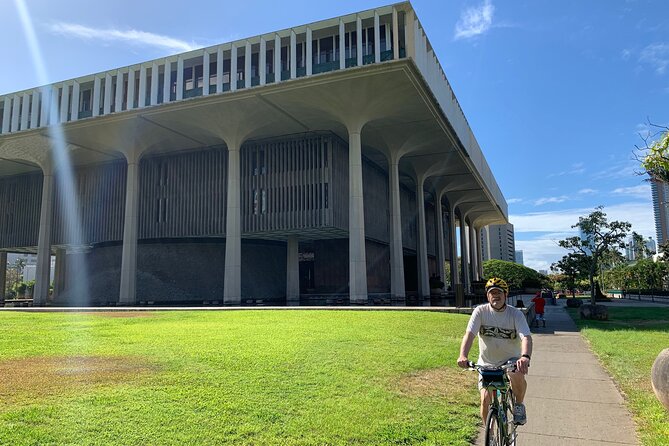
- Iolani Palace and the open-air state capitol
- Kakaʻako brings murals, food, and a changing city
- Ala Moana Beach Park opens the route to the water
- What you are likely to eat along the way
- Why the private format can justify the $189 price
- Timing, fitness, and what to bring
- Who will enjoy this Honolulu food ride
- Should you book the Tour de Honolulu?
- FAQ
- Where does the Tour de Honolulu begin?
- What time does the tour start?
- Where does the tour finish?
- How long does the tour last?
- Is this a private tour?
- Is a bicycle provided?
- Is a helmet included?
- What food is included?
- What language is the tour offered in?
- Can I cancel for a full refund?
Key points to know
- Private ride with guide Kelly: Your group has the guide to itself, allowing a more personal pace and plenty of questions.
- Waikiki is only the starting point: The route reaches downtown Honolulu, Kakaʻako, and Ala Moana.
- Food is part of the route, not an afterthought: Tastings can include fish tacos, Hawaiian pizza, kalua pork sliders, and shave ice.
- History comes in short, useful chapters: You’ll pass a 1929 canal, royal sites, the state capitol, and early missionary homes.
- Kakaʻako gets the longest stop: Plan on about 15 minutes among murals and new development.
- The tour returns to Kuhio Beach: The 1:00 pm start and same-place finish make this simple to fit into a Waikiki day.
A four-and-a-half-hour ride beyond Waikiki
This is a food tour with a substantial sightseeing route attached. You are not simply pedaling to one café, having a snack, and returning to the beach. The route covers several Honolulu districts and uses the bicycle to connect them without spending the whole afternoon in a vehicle.
The private format matters here. A guide can explain what you are seeing as you go, and your group does not need to match the speed or interests of a large mixed party. Kelly is the guide named in the tour details and guest accounts, and his role includes live commentary, route guidance, and the food stops.
The ride starts at Kuhio Beach on Kalākaua Avenue at 1:00 pm. You should arrive ready to ride, with comfortable clothes and enough sun protection for an outdoor afternoon. A helmet and bicycle are supplied, along with bottled water. Coffee or tea is also included.
The route is active but not presented as a hard athletic outing. The stated fitness requirement is moderate. That makes it a reasonable choice for people who ride bikes with some regularity, but it may feel long if you rarely cycle or if your group includes children who lose interest quickly.
A few more Oahu days out worth weighing up
- Hawaiian Food Tour by Bike in Oahu
★ 5.0 · 206 reviews - Diamond Head Bike to Hike and Local Lunch
★ 5.0 · 181 reviews - Kualoa Ranch: Novice E-Bike
★ 4.5 · 128 reviews
The Ala Wai Canal gives the ride its Waikiki frame
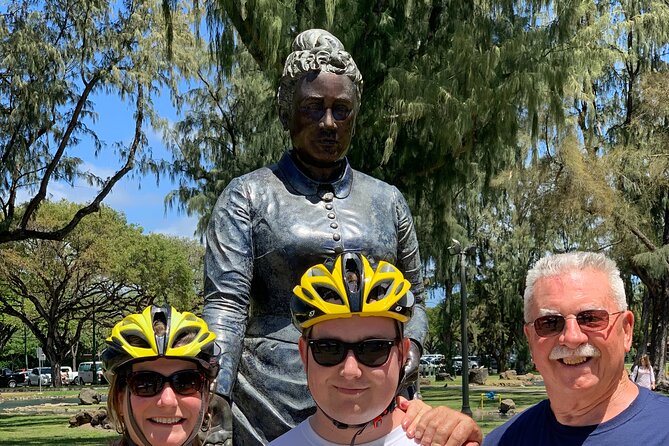
One of the first landmarks is the historic canal built in 1929. The Ala Wai Canal is a major feature of Waikiki, and seeing it from a bicycle helps you understand how the neighborhood is laid out. It also gives the tour a useful starting point: you begin with the familiar resort district, then move toward less visitor-focused parts of Honolulu.
The nearby Ala Wai Driving Range is a quick five-minute stop. The tour passes what it describes as the most popular golf course in North America, making this more of a local orientation point than a full attraction visit. You should not expect time for a round of golf or an extended look around.
That brief stop-and-go rhythm continues through much of the afternoon. You’ll pause, hear a compact explanation, take in the site, and get moving again. This suits you if you prefer seeing several parts of a city instead of spending an hour at one museum. It may feel rushed if you want long photo sessions or detailed indoor visits.
Elvis, the Blaisdell Center, and a slice of modern Honolulu
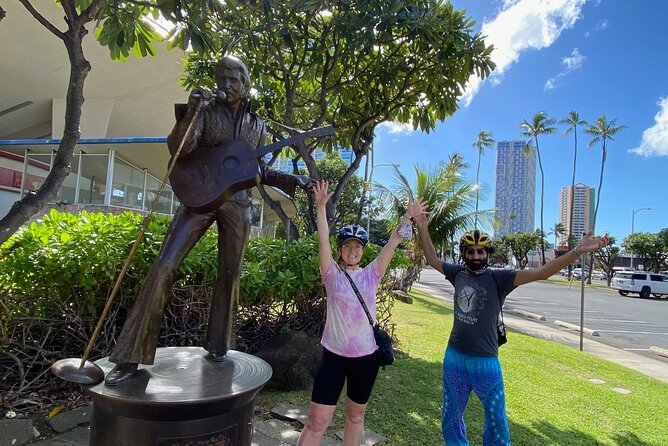
At the Neal S. Blaisdell Center, the group stops for about five minutes to see the statue connected with Elvis Presley. The site recalls his last concert in 1973, giving the ride a small piece of American music history alongside its Hawaiian subjects.
This is a good example of the tour’s broad approach. The afternoon is not limited to royal history or food. You get music, public buildings, neighborhoods, and everyday Honolulu mixed together. The stop is short, so the value comes from the guide’s explanation rather than from exploring the center itself.
The route then reaches the Hawaiian Mission Houses Historic Site and Archives. The tour identifies one of the buildings as the first western-style home built in Hawaii, brought from Massachusetts in 1820 and 1821. Even with only about three minutes here, the stop points to a major change in the islands and to the early contact between Hawaiian society and American missionaries.
You will need to listen closely because these stops move quickly. The guide’s live commentary is important, particularly for sites where you are not going inside. If you like a clear sense of place but do not need a long formal lecture, this format works well.
Iolani Palace and the open-air state capitol
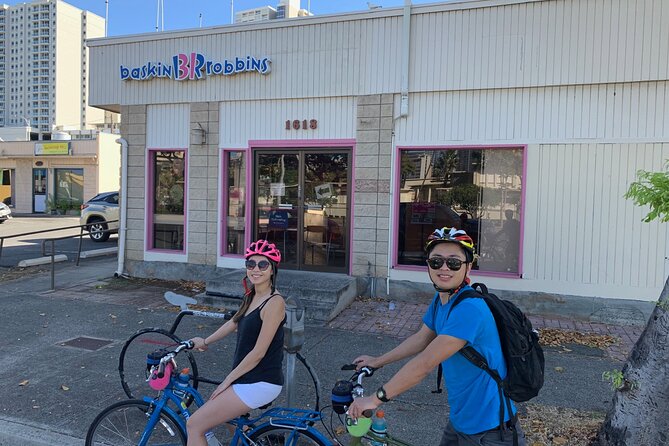
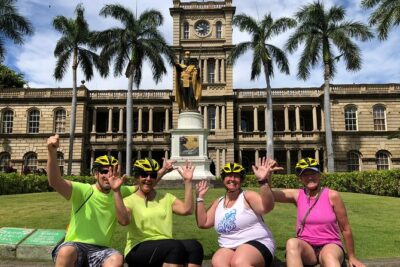
The bicycle gives you an easy way to roll around Iolani Palace, the only royal palace in the United States. A five-minute stop cannot replace a palace tour, but the exterior offers an important anchor for understanding Hawaii as a former kingdom.
I like this stop because it adds political history to the food and neighborhood riding. You are not just seeing pretty streets. You are passing a place tied to the Hawaiian monarchy and the country’s later transformation into a US state.
Nearby, the Hawaii State Capitol offers a sharp contrast. The tour calls it the only open-air state capitol in America and points out its unusual, out-of-the-box architecture. Again, the stop lasts about five minutes, so the focus is on the building’s design and role rather than an indoor visit.
These two landmarks work well together. One represents Hawaii’s royal past, and the other represents its modern government. The short time at each is a limitation, but the bicycle route lets you compare them without making either one carry the whole afternoon.
A different sort of day, same island:
- Oahu Grand Circle Island and Haleiwa Tour: 9-Hr Deluxe Experience
★ 5.0 · 17,387 reviews - Oahu: Grand Tour Around Island 16 Locations plus Snorkeling
★ 5.0 · 8,669 reviews - Parasailing Experience in Waikiki, HI
★ 5.0 · 7,692 reviews - Salute to Pearl Harbor Including USS Arizona
★ 4.5 · 7,433 reviews
Kakaʻako brings murals, food, and a changing city
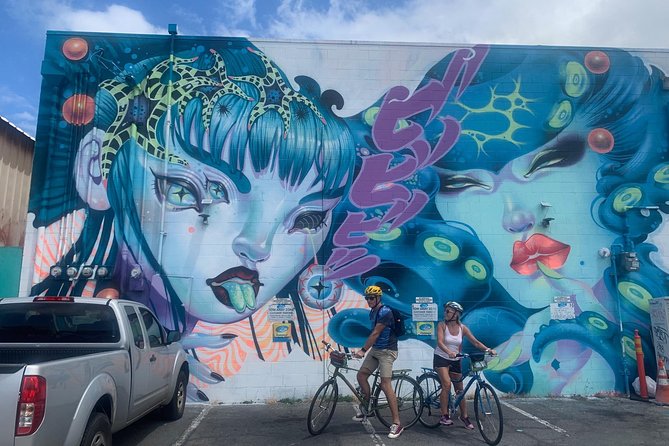
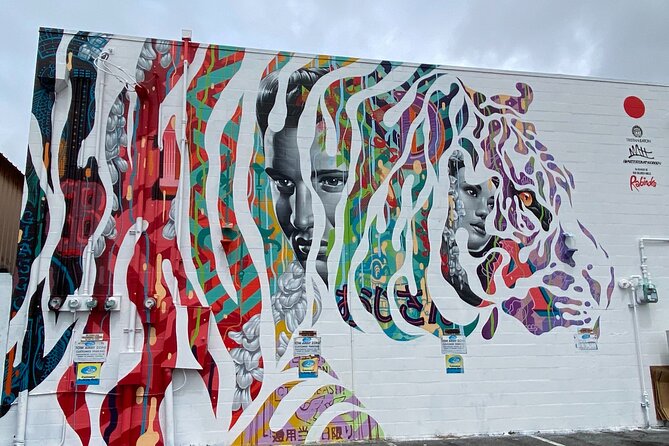
Kakaʻako receives the longest sightseeing stop, about 15 minutes. The district is presented as the future of Honolulu, with new development and large murals shaping its identity. You’ll ride through an area that feels different from the resort streets of Waikiki and the formal government district downtown.
The murals are a major reason to have a guide here. Public art can be easy to pass without context, and a local guide can point out the neighborhood’s changing character. The area also fits the tour’s central idea: Honolulu is not one uniform place. It shifts from hotel-lined beach streets to older civic landmarks and then to a newer district built around art and development.
There is also a practical food lesson in reaching Kakaʻako and other nonresort areas. The tour takes you beyond the places designed mainly for visitors and toward busy local food outlets. That does not mean every stop will feel quiet or unknown, but you get a better chance to see how Honolulu eats outside Waikiki.
The tradeoff is that Kakaʻako’s development is still part of the story. If you want old Hawaii at every stop, new buildings and large-scale construction may not be your favorite part. If you want to see where Honolulu is heading, this section gives the ride a useful present-day angle.
Ala Moana Beach Park opens the route to the water
Ala Moana Beach Park is described as a 100-acre park built in 1948 for the people of Hawaii. The five-minute stop is short, but the park gives you a different view of Honolulu’s public life. It is not a palace, museum, or shopping complex. It is a large civic space used for outdoor activities.
That distinction is valuable. A good city tour should show how local people use a place, not only the sites that appear in guidebooks. Here, you get a quick look at a park built for recreation and community life before returning toward the meeting point.
The route also passes the Hawaii Convention Center, established in the 1990s and covering more than 1,000,000 square feet. It adds another layer to the city: Honolulu is not only a beach resort, but also a major meeting and events destination.
These later stops help you read the city as a working place. You see public parks, government buildings, a convention center, new neighborhoods, and food businesses. That wider view is one of the strongest reasons to choose a bike tour instead of staying within Waikiki.
What you are likely to eat along the way
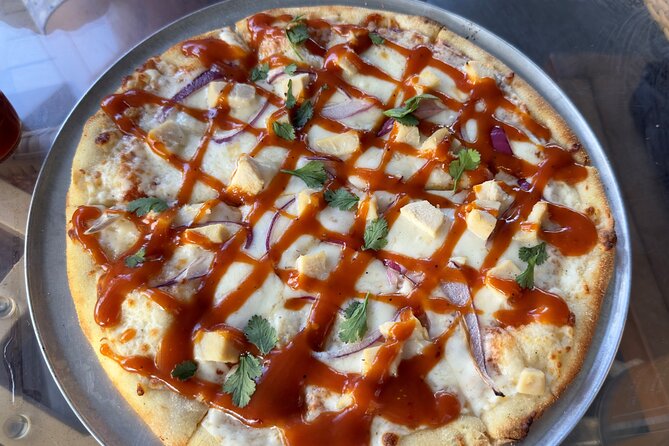
The listed tasting menu mixes familiar comfort food with local flavors. It includes a fish taco on a corn tortilla, Hawaiian pizza, kalua pork sliders, and shave ice for dessert. Bottled water, coffee, and tea are also included.
The menu is broad rather than narrowly traditional. A fish taco and pizza may not be the first foods you associate with Hawaiian cooking, but they reflect the casual, mixed food culture you find in Honolulu. Kalua pork brings a more distinctly local element, while shave ice provides the classic sweet finish.
The food is meant to break up the ride. That matters because you are spending much of the afternoon outdoors, and small tastings are easier to manage on a bike than a long sit-down meal. You should think of the included food as a series of samples, not a replacement for dinner.
The tour can also introduce you to foods beyond the printed sample menu. The food experience described by the provider includes local-style dishes such as poke, fish tacos, beef served in a leaf with coconut cream, doughnut-style buns, and shaved ice. The exact stops may vary, so do not book this expecting one fixed restaurant menu.
Shave ice is a particularly fitting dessert. The ice is cut very fine and served with your choice of flavors, making it a light finish in Honolulu’s warm afternoon. One distinctive option connected with the tour is a flavor associated with Obama’s favorite shave ice, though you should confirm the available choices on the day.
The local food focus is one of the tour’s best features, but it also creates uncertainty. If you have allergies or strong dietary restrictions, ask before booking. The supplied details do not promise vegetarian, vegan, gluten-free, or allergy-specific substitutions.
Why the private format can justify the $189 price
At $189 per person, this is not a budget bicycle rental. You are paying for a private four-and-a-half-hour experience that combines equipment, a guide, commentary, several food tastings, water, and a carefully connected city route.
The value is strongest if you want both sightseeing and food in one afternoon. A bicycle rental alone would not give you the local explanations, and a standard city sightseeing trip might not take you to small food outlets. The private setup also means your group is the only group participating, which can make the price easier to accept for families or friends who want control over the pace.
The price is less compelling if you mainly want a meal or a short ride. You will not spend long periods at each landmark, and the food is tasting-sized rather than a full restaurant lunch. I would compare it with the cost of renting a bike, paying for separate meals, and arranging your own route, then ask how much you value the guide and the local context.
This tour is booked well ahead on average, around 50 days in advance. That suggests you should reserve early if your Honolulu dates are fixed, especially because the private format limits the number of available groups.
Timing, fitness, and what to bring
The 1:00 pm start creates a useful afternoon plan. You can have a light breakfast or lunch beforehand, then use the tour as a late lunch and sightseeing outing. Since the activity ends back at Kuhio Beach, you are not left arranging a ride from another district.
Expect frequent stops, but do not mistake them for a relaxed stationary tour. You still have to pedal between Waikiki, downtown, Kakaʻako, and Ala Moana. A moderate fitness level is required, and the tour is best for people comfortable spending several hours on a bicycle.
Wear clothing suited to cycling and warm weather. The provided information confirms a bicycle and helmet, but it does not specify bike style, storage, child seats, or rain gear. If those details matter to you, ask Bike Tour Hawaii before booking.
The experience is offered in English. It is near public transportation, which helps with reaching the starting point at Kuhio Beach. Mobile ticketing and confirmation at booking make the basic arrival process simple.
Weather is important because this is an outdoor activity. If poor weather cancels the tour, you are offered another date or a full refund. You can cancel for a full refund up to 24 hours before the 1:00 pm start, but cancellations or changes inside that window are not refunded or accepted.
Who will enjoy this Honolulu food ride
I would choose this for a first or second Honolulu visit when you want a quick sense of how the city fits together. It is especially useful early in a vacation because the guide can help you understand Waikiki, downtown, Kakaʻako, and Ala Moana before you explore them on your own.
Families can also benefit from the mix of movement, food, and short stops. The private format is helpful when some people in the group ride more slowly than others. Still, the activity notes a moderate fitness level, and two of the children mentioned in the supplied accounts were not keen cyclists, so parents should be honest about their group’s comfort on bikes.
Food-focused visitors will appreciate the chance to try several Honolulu staples without committing to full meals at every stop. History fans will enjoy the royal palace, mission houses, state capitol, canal, and Elvis connection, though anyone wanting detailed museum time should plan separate visits.
I would hesitate if you dislike cycling in city areas, need a guaranteed dietary menu, or prefer a slow-paced palace and museum tour. The experience moves through many subjects quickly. Its strength is breadth, personal guidance, and the combination of riding with eating.
Should you book the Tour de Honolulu?
Book it if you want to see beyond Waikiki while tasting local food and you value a private guide more than a low price. The route offers a useful blend of Hawaiian monarchy, modern government, public parks, new Kakaʻako, and casual food stops, all without requiring you to plan the connections yourself.
Skip it if your priority is a long restaurant meal, a strenuous athletic ride, or extended time inside historic buildings. For the right group, though, $189 buys a well-filled afternoon, a bicycle, food, and a personal introduction to Honolulu that is broader than the beach district alone.
FAQ
Where does the Tour de Honolulu begin?
The tour begins at Kuhio Beach, 2453 Kalākaua Avenue, Honolulu, Hawaii 96815.
What time does the tour start?
The start time is 1:00 pm.
Where does the tour finish?
The activity ends back at the Kuhio Beach meeting point.
How long does the tour last?
The tour lasts approximately four hours and 30 minutes.
Is this a private tour?
Yes. Only your group participates in the private activity.
Is a bicycle provided?
Yes. Use of a bicycle is included.
Is a helmet included?
Yes. A helmet is provided for the ride.
What food is included?
The listed tastings include a fish taco on a corn tortilla, Hawaiian pizza, kalua pork sliders, and shave ice. Bottled water, coffee, and tea are also included.
What language is the tour offered in?
The tour is offered in English.
Can I cancel for a full refund?
Yes. You can cancel at least 24 hours before the experience start time for a full refund. Cancellations or changes made less than 24 hours before the start are not refunded or accepted.
Just added around Oahu
- Mokulua Islands Self-Guided Kayak Adventure★ 3.5 · 3 reviews
- Kevo’s Beach Bus★ 5.0 · 3 reviews
- 2hr Luxury Private Sailing Catamaran for 7-12 People★ 5.0 · 3 reviews
- Night Ninja Adventure Course in Kapolei★ 3.5 · 3 reviews
- Arrival Lei Greeting –HNL to Waikiki Private Transfer★ 5.0 · 3 reviews
- Private “Limousine” USS Arizona Memorial & Cultural Honolulu Tour★ 5.0 · 3 reviews
- Surf Lessons get your Social Media video & photos you Surfing HI.★ 5.0 · 3 reviews
- (2nd)Diamond Head Hike w/ Malasada Starts at 7:00 a.m.★ 3.3 · 3 reviews
Cycling Tours, compared.
Half Day Oahu Combo Adventure: Bike, Sail and Snorkel
Read our review →Browse the lists this tour appears in